
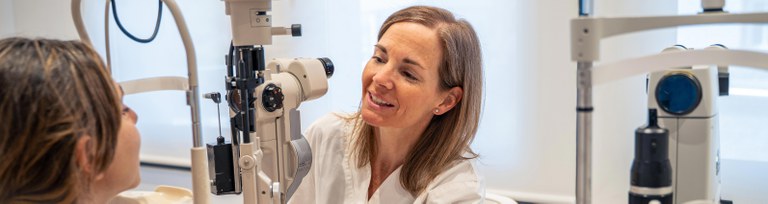
What are the risks of wearing contact lenses during the summer?
The Ophthalmology service at Clínica Sant Josep explains one of the most prevalent corneal infections in summer, infectious keratitis
In summer, it is very common for people who need glasses to look for a more comfortable alternative when they go to aquatic environments, such as the beach or swimming in a pool. According to the Spanish Contactology Society, 2.5 million people use contact lenses in Spain, a figure that increases during the summer months when more outdoor activities take place.
The Ophthalmology service at Clínica Sant Josep explains one of the most prevalent corneal infections in summer, infectious keratitis, which can lead to more serious problems. Contact lens use is a risk factor for developing this infection, especially when lenses are not used properly, such as in pools and at the beach.
What exactly is it and who does it affect?
Infectious keratitis is an infection of the cornea —the transparent layer at the front of the eye that focuses images—. It can be caused by bacteria, fungi or amoebae. As Dr Núria Planas, an ophthalmologist in the Ophthalmology service, explains, “non-sterile water from taps, rivers, pools and the sea can contain pathogenic micro-organisms such as the parasite Acanthamoeba. Contact lenses, if hygiene is not maintained, can retain these germs directly against the cornea and cause micro-lesions or even a serious infection”.
For this reason, the service stresses that “swimming or rinsing contact lenses with tap, pool or sea water is extremely risky”.
How can we detect it in time?
Early symptoms usually appear quickly and should set off alarm bells. Warning signs include severe pain or discomfort in the eye, redness, extreme sensitivity to light (photophobia), blurred vision i, si es mira en detall, pot aparèixer una taca blanca a la còrnia acompanyada de secreció ocular.
Given these signs, it is very important to distinguish symptoms associated with simple irritation or everyday fatigue from those that may indicate an infection. As Dr Planas explains, “irritation caused by tiredness and dryness improves when the contact lens is removed and artificial tears are applied. But keratitis causes persistent pain that does not go away, a constant feeling of a foreign body and a noticeable loss of vision that is not corrected by blinking. If you experience this, you should see an ophthalmologist immediately.”
The danger of bad habits with contact lenses
Another common mistake is napping or sleeping all night with contact lenses in. During sleep the eyelids are closed and the eye receives less oxygen; combined with a lens, this creates a warm, moist environment perfect for bacteria to proliferate unchecked.
Ignoring usage instructions, such as the lifespan of the lens, or storing lenses in unsuitable cases or at high temperatures, can allow bacteria and fungi to proliferate with disastrous consequences for vision: from corneal ulcers and permanent scars that irreversibly distort sight to total loss of vision or the need for a corneal transplant in extreme cases.
As a preventive measure, the Ophthalmology service at Clínica Sant Josep recommends avoiding swimming with contact lenses. If use cannot be avoided, daily disposable lenses together with well-fitted swimming goggles are preferable, and lenses should be removed and discarded immediately after swimming.
They also remind people to always wash their hands before handling contact lenses, never rinse them with tap water, replace the lens case regularly, not sleep with lenses in, and seek professional help immediately if there is pain, vision loss or intense redness.
To schedule an appointment with the Ophthalmology service, call 93 874 42 98 or book online via espaipacient.clinicasantjosep.cat.
It is also worth remembering that Clínica Sant Josep has an dophthalmology emergency service, de Monday to Friday, from 9 a.m. to 1 p.m. and from 3 p.m. to 7 p.m.
You can check public holidays and some exceptions to Ophthalmology service hours on the website: https://www.clinicasantjosep.cat/serveis-medics/especialitats/oftalmologia


