
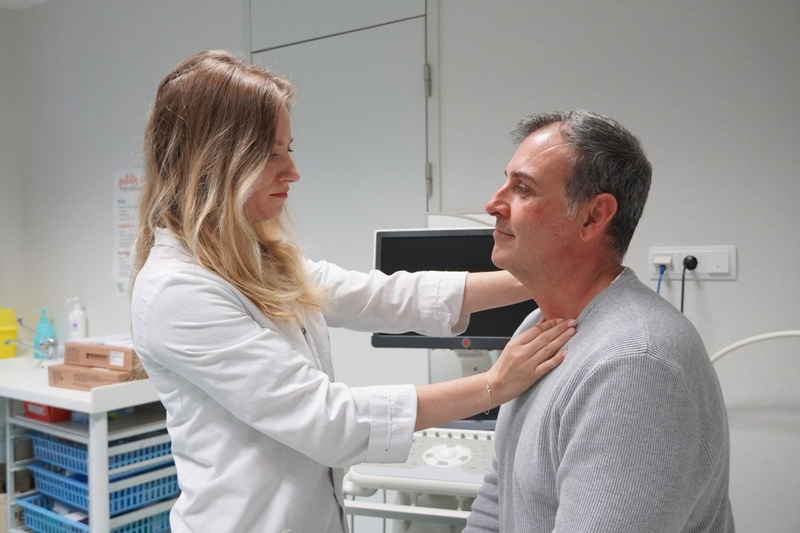
The thyroid, a key gland for our body
Dr. Núria Seguí, of the Endocrinology Service at Clínica Sant Josep, explains why the thyroid matters and the diseases caused when it malfunctions
The thyroid is a small gland of the endocrine system, shaped like a butterfly, which is located in the front of the neck. But despite being small, it plays a very important role in the functioning of our body. As explained by Dr. Núria Seguí, from the Endocrinology Service of Clínica Sant Josep, this gland is responsible for secreting two hormones, thyroxine and triiodothyronine, regulators of various essential processes such as body temperature, energy levels, muscle functions or metabolism. It also plays a key role in growth. For this reason, having good thyroid health is essential. But what happens if this gland is not working properly? We'll explain it below.
Among the most common disorders, we find hypothyroidism and hyperthyroidism. The first appears when there is insufficient production of hormones. According to Dr. He continued, "this pathology affects more women than men and its prevalence increases with age". Dry skin, hair loss, slow heartbeat, constipation, muscle aches and weight gain are some of the symptoms.
In contrast, hyperthyroidism occurs when the thyroid produces an excess of thyroid hormone. The most common cause is usually Graves Basedow disease, an inflammation caused by antibodies and, unlike hypothyroidism, the person is nervous, has an increased heart rate, feeling hot, insomnia and weight loss.
Apart from these two diseases, another alteration of the thyroid is thyroid nodules, a very common condition that mainly affects people over the age of 60 and which in the vast majority of cases is benign. Generally, the nodules are asymptomatic, but sometimes, if they are very large, they can cause discomfort in the neck or difficulty swallowing.
How can we deal with them?
If you have symptoms of hypothyroidism or hyperthyroidism, it will be crucial to have a blood test to determine if the thyroid is working well. If what is presented is discomfort in the neck or if it increases in size, for example, it will be necessary to opt for a thyroid ultrasound. Dr. Seguí emphasizes that it is "a very useful and non-invasive test, which allows you to see the structure of the thyroid and detect if there are nodules". If there are any, it will be necessary to analyze their characteristics to see if they are malignant or not.
Dr. Seguí adds that the treatment will depend on the cause. If we are faced with a case of hypothyroidism, it will be necessary to replace the missing hormone with levothyroxine. In the case of hyperthyroidism, the procedure will depend on whether it is of autoimmune origin or whether the cause is nodules. If it is a multinodular goiter, an irregular growth of the thyroid gland, the solution will be based on radioactive iodine. Depending on the characteristics of the nodules, the treatment can range from periodic monitoring, with an ultrasound check, to surgery.
In order to properly synthesize thyroid hormones, it is essential to have "a good supply of iodine, an essential mineral for the production of thyroid hormones", explains the endocrinologist at Clínica Sant Josep. Fish, shellfish or iodized salt, for example, are foods rich in this mineral. Iodine deficiency causes a reduction in the synthesis of thyroid hormones, affecting the metabolism of all cells in the body. Apart from this mineral, it is also crucial to "have a balanced diet and not lead a sedentary life", adds Dra. Followed.


