
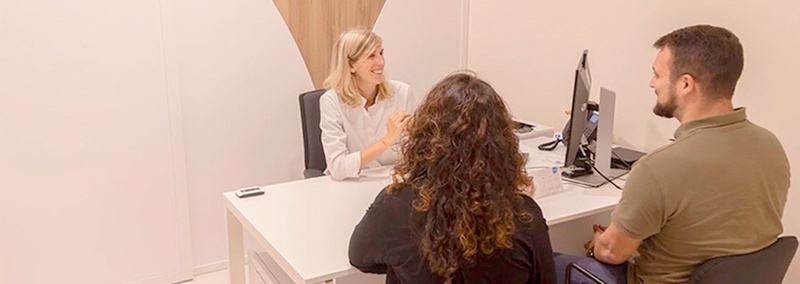
"Infertility affects 15% of couples trying to conceive"
What are the fertility studies carried out by the Service Dexeus Dona at Clínica Sant Josep? Dr. Núria Murcia, specialist in assisted reproduction, explains it to us
During the month of June, World Fertility Month is commemorated, with the aim of visualizing this reality that affects couples and individuals and that often involves an emotionally intense process. According to Dr. Núria Murcia, gynecologist and specialist in assisted reproduction from the Gynecology, Obstetrics and Assisted Reproduction Service offered by Dexeus Dona at Clínica Sant Josep, considers infertility the inability to achieve or maintain a pregnancy after "twelve months of unprotected sexual intercourse". This period can be a stage of great anxiety and uncertainty for those people who dream of motherhood or fatherhood.
When this desire does not come true naturally, the service offers a path through assisted reproduction techniques. These techniques not only provide a medical solution, but open the door to a new opportunity for many individuals and couples.
A process of study and diagnosis
The first step when deciding to seek help is to do a complete fertility study. Although these tests are usually performed on people who have difficulty conceiving, they are also useful if there is a family history of abortions or gynecological problems, if you decide to postpone motherhood or, simply, if you do not rule out becoming a mother in the future. Its objective is to check if everything is working correctly and to assess the chances of having offspring.
The infertility test is simple and allows you to obtain results in fifteen days
According to Dr. Murcia, the process is neither complicated nor long: "If you don't need to do a special test, the test is simple and allows you to get results in fifteen days". This study includes the first medical visit to assess the clinical history, lifestyle habits, family history and general health status. A blood analysis is also carried out which includes a hormonal study, as well as a physical examination with cytology and vaginal palpation to detect infections or abnormalities. In addition, a vaginal ultrasound is performed to examine the uterus and ovaries. Other optional tests can also be done, such as mammograms in patients over 40 or joint tests with the partner.
Key parameters to evaluate fertility
Although each case is assessed individually, there are a series of common parameters that professionals look at, such as ovarian reserve, which is carried out by counting the follicles present in the ovaries and a hormonal study.
The vaginal ultrasound to rule out irregularities or detect anomalies such as fibroids, polyps, cysts or uterine malformations and is also part of the follicle count. During the physical examination, the breasts are also checked and, in some specific cases, the patency of the fallopian tubes. In those cases where a joint test is carried out with a male partner, the seminogram is also evaluated, which allows checking the quality of the sperm.
Techniques of assisted reproduction
When tests determine a cause or even when no specific problem is identified, techniques such as artificial insemination can be applied, which consists of introducing a sample of processed semen directly into the uterus during the ovulatory period, or in vitro fertilization (IVF), which stimulates the ovaries to produce several eggs, which are fertilized with sperm in the laboratory and introduced into the uterus as embryos.
Emotional support: a key piece
Treatments can be psychologically demanding, and do not always result in pregnancy. For this reason, Dr. Murcia insists on the importance of emotional support, which helps to manage frustration, fears and hopes. "Having specialized psychological support can make a difference on this path."
As the specialist comments, assisted reproduction "is much more than a medical solution: it is a combination of science, support and hope". Through accurate diagnoses, advanced techniques and human support, many couples can find a new opportunity to make their desire to become mothers or fathers come true.


